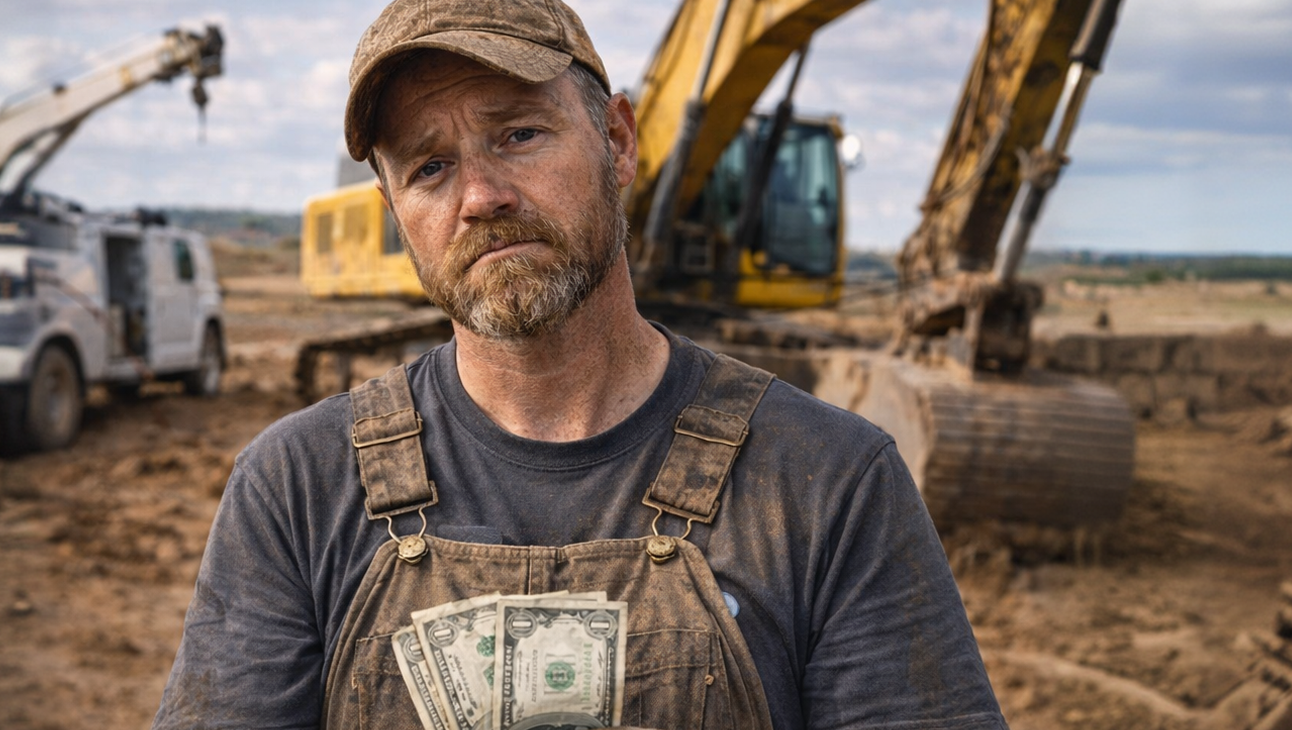
There’s a quiet crisis happening in the dirt — on construction sites, in mining operations,and across the farms that feed the country. The people who keep the heavy iron running are getting older, and not enough young people are stepping up to replace them. Caterpillar excavators, John Deere graders, Komatsu bulldozers — these aren’t machines that fix themselves. But the trade that maintains them is hollowing out, and the reason is almost embarrassingly straightforward: the pay has never caught up to the work.
Meanwhile, over the last two decades, we watched entirely different skilled trades explode. Software engineering didn’t just grow — it became the defining career aspiration of a generation. Computer science enrollment surged. Coding bootcamps popped up everywhere. Parents started steering their kids toward keyboards instead of wrenches. And the reason was just as simple: the money was extraordinary, and the demand was insatiable.
Nursing tells a different but equally instructive story. The demand for nurses has always been there — hospitals don’t run without them. What changed was the market’s ability to price that demand honestly. A wave of nursing marketplaces emerged that let skilled nurses find shifts on their own terms, pick up work during high-demand periods like holidays or staffing crunches, and capture something closer to their actual market value rather than whatever a single employer decided to pay. Travel nursing took off for the same reason. When nurses gained the ability to move toward the best compensation, they did — and the profession became significantly more attractive as a result.
Both trades share a common characteristic with heavy equipment mechanics —genuine, persistent, structural demand. Nobody is automating away the need for nurses any more than they’re automating away the need for the machines that build our infrastructure. Infrastructure gets built. Mines get worked. Pipelines get laid. And when a $500,000 piece of iron breaks down on a job site, someone who knows what they’re doing has to fix it, fast. The demand is real. The shortage is real. The problem is that fordecades, the compensation hasn’t reflected either one.
When software engineering started pulling serious money — $100,000 entry-level salaries, equity, remote work, stock options — it didn’t just attract people who loved writing code. It attracted smart, ambitious people who recognized a market signal. The trade made a credible promise: invest a few years in learning this, and you’ll be rewarded handsomely for the rest of your career. That promise was kept, loudly and publicly, enough times that it reshaped how an entire generation thought about their futures.
Nursing cracked a version of this too, not by inflating base salaries overnight, but by giving nurses the tools to find their market rate. Marketplace platforms connected supply and demand in real time — a hospital short-staffed on a Tuesday night could find a qualified nurse, and that nurse could command a premium for showing up when the need was acute. Transparency and mobility did what stagnant wage structures never could: they made the economics of nursing visible and actionable.
Heavy equipment mechanics never had either of those things. Average wages have historically hovered in the low-to-mid fifties in most markets — respectable, but not aspirational. Not the kind of number that travels. Not the kind of number that makes a high school junior reconsider their college plans or convinces a parent that a vocational path is worth betting on. The work is physically demanding, the hours are irregular, and the environment is often brutal. Against that backdrop, the compensation hasn’t been compelling enough to drive the pipeline that the industry desperately needs.
This isn’t a knock on the work itself. A diesel mechanic diagnosing a hydraulic failure on a 50-ton excavator is doing something genuinely complex — reading fault codes, working through electrical systems, understanding fluid dynamics, and doing it all undertime pressure with a job site worth of costs mounting by the hour. The cognitive load is real. The skill ceiling is high. The training takes years. But the market hasn’t priced it that way.
Some mechanics didn’t wait for the industry to figure it out. They left.
Over the past decade, a growing number of experienced heavy equipment mechanics have walked away from OEM dealerships to go independent — and the economics are the obvious reason why. A dealer tech generates significant revenue for the shop but captures only a fraction of it. The hourly billing rate goes to the house; the mechanic gets a wage. Go independent, and that equation flips. You set the rate, you keep the margin, you build the customer relationships. The trade-off is the overhead, the uncertainty, and the business complexity that comes with running your own operation. For mechanics with the skills and the hustle to manage it, the upside has proven to be substantial.
This mirrors what happened in both software and nursing. Developers left big companies to consult and freelance. Nurses found platforms that let them work on their own terms. In each case, the talent recognized its own market value and found ways to capture more of it. Independent mechanics are doing the same thing — just with a service truck instead of a laptop or a set of scrubs.
Let’s be direct about something: OEM dealers have had decades to fix this, and they haven’t.
Instead of addressing the compensation gap, the industry’s response has largely been to shrug and complain that “nobody wants to be a technician anymore.” Blame the younger generation for not wanting to work hard. That framing is both self-serving and wrong. People want good careers. Young people are increasingly clear-eyed about the trade-offs in front of them — skyrocketing college debt, a job market being reshaped by AI, and growing uncertainty about which credentials lead to financial security. A skilled trade where someone can genuinely earn $200,000 or more per year is not a hard sell in that environment. It’s a compelling one.
The problem isn’t the trade. The problem is that legacy OEM dealers have spent decades depressing wages, and the market has noticed. The technicians noticed first —and left. Now the dealers are left holding a staffing crisis of their own making, scratching their heads about a pipeline problem that is, at its core, a compensation problem. You can’t pay people like it’s 1998 and wonder why the shop is understaffed in 2025.
The deeper irony is that dealers bill customers at rates that should support competitive technician pay. The margin exists. The choice not to pass it through to the people doing the work has been just that — a choice. Despite telling everyone internally that service is the most important department, dealer sales reps pocket significantly more money. And the consequences of that choice are now unavoidable.
This is the bet behind Heave. We built a platform to give independent heavy equipment mechanics the infrastructure to operate like a real business — and the operational support that’s historically been out of reach for someone working on their own.
That means faster payment terms that reduce collection risk, so a mechanic isn’t floating invoices for 60 or 90 days waiting on a customer to cut a check. It means access to insurance coverages that make it possible to work with larger customers who have requirements that most independents simply can’t meet on their own. It means back-office support — the administrative and operational layer that eats time and energy when you’re trying to run a one-person shop while also doing the actual work. And it means something that’s easy to underestimate: the ability to build a real brand. Through verified customer reviews and exposure to a market that an independent mechanic could never reach on their own, Heave gives skilled technicians a way to let their reputation travel — and work for them.
The early results have been striking. Since 2023, technician earnings have grown substantially on the Heave app. In 2025, ten technicians earned over $200,000, with 3 individuals exceeding $400,000!
That number is worth sitting with. Four hundred thousand dollars. From fixing heavy equipment. These aren’t outliers in the sense of being anomalies — they’re outliers in the sense of being early. They figured out that the demand was always there, the market rate for skilled work was always higher than what dealers were paying out, and the missing piece was a platform that handled everything that isn’t turning wrenches —and put their name in front of the customers who needed them.
That’s the argument we’re making with every mechanic who joins the platform: this trade has always had the demand. It’s always had the complexity and the skill requirement to justify serious compensation. The only thing standing between a great mechanic and real earning power has been structure — and that’s a solvable problem.
Here’s what makes this particularly ironic: heavy equipment mechanics may be among the most AI-resistant jobs in the entire economy.
The roles most vulnerable to AI displacement share a common profile — they involve pattern recognition, language processing, and decision-making that can be codified and scaled. White-collar knowledge work, entry-level legal research, basic coding tasks, customer service, content production — these are all in the crosshairs. The jobs that require physical presence, hands-on diagnosis, and manipulation of complex machineryin unstructured environments are far harder to automate. A robot isn’t crawling under a grader in a muddy field in February to swap out a failed final drive. Not now, and not soon.
Software engineers — the very people who displaced the career ambitions of an entire generation of young workers — are now themselves navigating real uncertainty about what AI means for their roles. Junior development positions are getting squeezed. The economics of the trade are shifting in ways that weren’t predictable five years ago.
The heavy equipment mechanic, by contrast, is working in exactly the kind of physical, contextual, variable environment that makes automation genuinely hard. The irony is almost too neat: the trade that couldn’t attract talent because the pay seemed low is now one of the more defensible careers in the economy. And the trade that sucked up all that talent with promises of high pay and prestige is the one staring down an uncertain AI future.
The answer isn’t complicated, even if executing it is. Compensation has to move. Not marginally — meaningfully. The trades that have attracted talent have done so by making an economic argument that’s hard to ignore. Electricians in high-cost markets pulling six figures. Plumbers with full books and waiting lists who price accordingly. The skilled trades that have cracked this have done it by treating labor scarcity as the pricing signal it actually is.
The broader industry is still operating on compensation assumptions that were set in a different era, when the competition for young workers was less intense and the cultural pull of tech careers didn’t exist. That era is over. But the independent mechanics who’ve gone out on their own — and the platforms enabling them to do it at scale — are already writing a different story. One where the machines still get fixed, and the people fixing them are finally getting paid what the work is worth.
